
rust
Helio VR: OpenXR Integration Through wgpu's Vulkan Escape Hatch
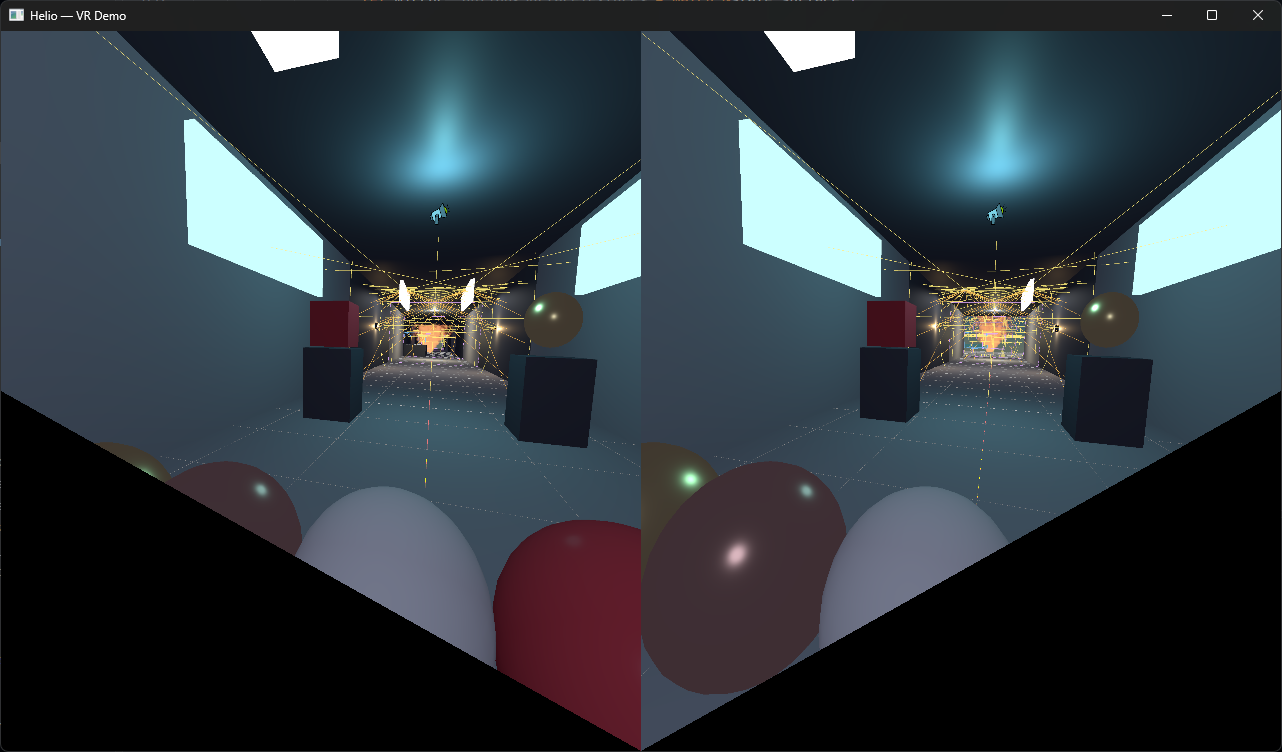
How Helio drives an HMD through OpenXR: Vulkan instance and device created through the runtime, dual-pass stereo rendering through existing forward pipelines, asymmetric-FOV camera math with a documented clip-space bug, controller input across four interaction profiles, and a PC mirror blit that shows both eyes side by side.

Helio's renderer was built for flat screens. Single camera, deferred shading, temporal accumulation, shadow cascades, foliage, water, post-processing. Fifty passes wired into a graph targeting one wgpu::TextureView at your monitor's resolution. VR meant the same pipeline had to render two views at 90 Hz with asymmetric per-eye frustums. Controller input through a runtime that owns your GPU device. A swapchain whose images you cannot free.
The principle was straightforward: activate the existing forward-capable pipeline in stereo mode. RendererConfig::enable_xr flips a flag at build time. The graph executor injects multiview_mask = 0b11 on every render pass. The texture pool allocates internal targets as 2-layer D2Array textures. The camera storage buffer grows from one slot to two. Every shader, every post-effect, every draw call works unchanged. The same submit_frame call with a different texture view.
Building that bridge meant reaching into wgpu and extracting raw Vulkan handles. OpenXR expects VkInstance, VkPhysicalDevice, VkDevice, VkImage. It insists on creating them itself through xrCreateVulkanInstanceKHR and xrCreateVulkanDeviceKHR. The runtime injects its own extensions and picks the physical device the HMD is driven by. On a laptop with integrated and discrete GPUs, the runtime picks the discrete one. You cannot create your own VkInstance and hand it to OpenXR. The runtime rejects it.
Every handle came out through as_hal::<Vulkan>(). Every wrapped handle went back through Instance::from_raw, expose_adapter, device_from_raw, and create_device_from_hal. Every one of those calls is unsafe. Every one is pinned to the exact wgpu 30.0.0 hal API surface. The boundary is thin, version-sensitive, and cannot be tested without a headset.
The Hal Escape Hatch
wgpu-hal is the internal backend abstraction layer that wgpu's safe API sits on top of. Normally an application never touches it. The XR path bypasses wgpu::Instance::new() entirely.
The instance creation in context.rs:create_wgpu_instance starts by querying wgpu-hal for the Vulkan extensions it needs:
desired_extensions returns wgpu-hal's list: VK_KHR_surface, VK_KHR_win32_surface (or the platform equivalent), debug extensions, and the timeline semaphore extension. These are the exact extensions wgpu expects to be present on a normal VkInstance. We build a VkInstanceCreateInfo from them and pass the pointer to OpenXR.
The get_instance_proc_addr transmute sits at the boundary:
Both ash and openxr::sys define this function pointer type. They define it as separate types. The ABI is identical, the raw PFN_vkVoidFunction (*)(VkInstance, const char*) from the Vulkan header, but Rust treats them as incompatible. The transmute asserts they are layout-identical. If ash ever changes its function pointer ABI this breaks silently.
OpenXR merges its own required extensions into the VkInstanceCreateInfo: VK_KHR_external_memory_capabilities, VK_KHR_get_physical_device_properties2, the platform-specific surface extension for the compositor, and debug utils if available. The resulting VkInstance is wrapped back into wgpu through from_raw:
The from_raw call takes ownership of the VkInstance. It treats it as if wgpu-hal had created it. wgpu's resource tracker, its deferred barrier logic, its allocation pools all operate on an instance whose creation they did not control. If OpenXR injected an extension wgpu does not know about, from_raw returns an error.
The device path is deeper. The physical device comes from OpenXR:
This is xrGetVulkanGraphicsDevice2KHR. The runtime knows which GPU the HMD is connected to. On a laptop with integrated and discrete GPUs, the runtime returns the discrete one. The function takes the raw VkInstance handle cast to a u64, the same instance we just created through OpenXR.
The HAL adapter is exposed through expose_adapter:
This asks wgpu-hal to wrap the VkPhysicalDevice in its internal ExposedAdapter struct. The struct carries the device's feature set, limits, and wgpu-hal's own adapter object. The feature set is masked against what the application requested. Features::MULTIVIEW is required and the function fails if the HMD does not support it.
The logical device is created through OpenXR, then wrapped with device_from_raw:
The None render-bundle cache is worth noting. wgpu-hal normally creates a RenderBundleCache alongside the device for acceleration structure encoding. Passing None disables it. The XR device path does not use render bundles, so there is no hit.
create_device_from_hal wraps the hal device into a full wgpu::Device with a Queue:
The device_desc carries the limits separately because this path bypasses request_device entirely. The limits must be rebuilt from the HAL adapter's capabilities rather than going through wgpu's normal limit negotiation.
Limits Negotiation When OpenXR Owns the Device
request_device does not get called. OpenXR owns the VkDevice, so wgpu's normal device creation pipeline where it validates limits against the adapter and negotiates them down is replaced entirely. The limits are built in create_wgpu_device from hal_adapter.capabilities.limits:
The max_sampled_textures cap at 256 mirrors Helio's bindless texture table limit. The max_multiview_view_count = max(2) ensures multiview can address both eyes even if the adapter reports a lower default.
The max_buffer_size cap exists because wgpu-core asserts max_buffer_size <= u32::MAX at wgpu-core/src/indirect_validation/draw.rs:72. An RTX 4090 reports 16 GiB of addressable buffer. That assertion panics at device creation:
The error surfaces on the XR path only, because the normal request_device path applies its own clamping. The fix is the min(u32::MAX as u64) on line 186. Without it, the device creation panics before the first frame and the symptom is "VR is broken" rather than "limits problem."
The normal helio::required_wgpu_limits function is not called. The limits code in context.rs duplicates those caps explicitly, and the comment at line 177 warns that any future limit change must be mirrored here. There is no shared function.
The Graphics Trait and Why It Exists
The openxr crate ships a vulkan module implementing its Graphics trait. It has the right associated types: Format = u32 (VkFormat) and SwapchainImage = u64 (VkImage handle). But it is generic over openxr::Swapchain<openxr::vulkan::Vulkan>, and Helio's swapchain is Swapchain<WgpuGraphics>.
WgpuGraphics at graphics.rs:25 is a zero-sized marker type. It delegates every Graphics trait method to the built-in openxr::vulkan::Vulkan implementation except enumerate_swapchain_images:
The only method that differs is enumerate_swapchain_images. The built-in one calls xrEnumerateSwapchainImages through the openxr::vulkan::Vulkan vtable. It returns SwapchainImageVulkanKHR structs. But Swapchain<WgpuGraphics> has a different PhantomData than Swapchain<openxr::vulkan::Vulkan>, and the built-in method only implements the generic for the latter. Re-implementing enumerate_swapchain_images means calling the raw fp.enumerate_swapchain_images function pointer directly, enumerating into a Vec<SwapchainImageVulkanKHR>, and extracting the image: u64 handle from each:
The alternative would be to use openxr::vulkan::Vulkan throughout and cast the swapchain handle at the call sites. But that leaks the PhantomData mismatch into every function that touches the swapchain. The newtype isolates the mismatch in one place.
Wrapping OpenXR Swapchain Images
OpenXR allocates the swapchain images and owns their memory. Each acquire_image returns an index into a fixed pool of VkImage handles that are stable for the swapchain's lifetime. The images are enumerated once at startup and wrapped into wgpu textures.
wrap_vk_image at swapchain.rs:198 takes a raw u64 handle, creates a wgpu::TextureDescriptor matching the swapchain's dimensions and format, builds a hal-level TextureDescriptor, and calls hal_device.texture_from_raw:
TextureMemory::External tells wgpu-hal that the image's backing memory is not owned by wgpu and must never be freed. The no-op drop callback means the hal texture wrapper can be dropped without side effects. If wgpu tries to destroy this texture through its normal lifecycle, a graph rebuild or Renderer drop, the no-op callback prevents the VkImage from being freed. OpenXR owns the image. OpenXR returns it to the runtime's pool on release_image.
The wgpu texture is created with TextureUses::UNINITIALIZED:
UNINITIALIZED tells wgpu's resource tracker that the image's contents and layout are unknown. On acquire_image, the runtime may have transitioned the image to VK_IMAGE_LAYOUT_COLOR_ATTACHMENT_OPTIMAL or VK_IMAGE_LAYOUT_SHADER_READ_ONLY_OPTIMAL or any other layout. wgpu's tracker emits the first barrier as a legal discard, from VK_IMAGE_LAYOUT_UNDEFINED to the layout the first render pass expects, without validating the previous state. Using UNINITIALIZED instead of a known initial layout avoids a tracker assertion when the runtime's layout does not match wgpu's expectation.
Two views are created per image. A D2Array view for the swapchain array render target and per-layer D2 views for per-eye rendering:
The array views are what the multiview code path will use. The layer views are what the current dual-pass path uses, passing one eye's layer to each submit_frame call.
The 2-layer swapchain is requested first. If the runtime rejects it, SteamVR on some driver versions or older Oculus runtimes, the fallback creates a 1-layer swapchain and sub_image_rect splits the image width between the two eyes:
Format negotiation maps between wgpu's TextureFormat and Vulkan's VkFormat numeric values. The mapping is a direct switch on known formats: Rgba8UnormSrgb is VK_FORMAT_R8G8B8A8_SRGB (numeric value 43), Bgra8UnormSrgb is 50, Rgba16Float is 97. If the requested format is not in the runtime's advertised list, the code falls back to the first runtime format it knows how to wrap.
The Session Create Info Extraction
vulkan_session_create_info in session.rs:338 extracts raw Vulkan handles from wgpu and describes them in the form OpenXR expects:
raw_instance() returns the ash::Instance. raw_physical_device() returns the vk::PhysicalDevice. raw_device() returns the vk::Device. Each handle is cast to *const c_void, the raw pointer form OpenXR's C API expects. The queue_family_index and queue_index are queried from wgpu-hal's device. They were recorded at its own device_from_raw call.
The session is created with a guard that keeps the wgpu Instance and Device alive for the session's lifetime. Without the guard, dropping the Renderer would destroy the underlying Vulkan device before the session does:
The signature pattern, create_session_with_guard taking a Box<dyn Any>, is OpenXR's mechanism for associating user data with the session. The box is leaked to the runtime and freed when the session is destroyed. Without the guard, Renderer::drop would destroy the VkDevice while OpenXR still held references to it. That is a use-after-free.
The Renderer's XR State
The Renderer struct at renderer_impl.rs:64 carries XR-specific fields behind #[cfg(not(target_arch = "wasm32"))]:
xr_depth_texture is a Depth32Float 2-layer array created by create_xr_depth_resources in setup.rs:48. It is the depth-stencil attachment for the multiview render pass. A D2Array view is the target the graph executor binds when multiview_mask = 0b11. A separate D2 view of layer 0 is provided for passes that sample depth as a plain texture_depth_2d. HiZ construction, lens flare, and SSAO all need this. A D2Array view cannot be bound to a D2 bind-group entry.
xr_mirror_bind_group is cached per swapchain image index. The key (u32, BindGroup) lets the blit reuse the bind group across frames for the same image index, rebuilding only when the acquired image changes:
The mirror pipeline is lazily created and cached. It is keyed on the mirror surface's colour format, set by set_xr_mirror_format and typically Bgra8UnormSrgb on Windows. When the format changes, a monitor resolution change or a window move between displays with different pixel formats, the pipeline is dropped and rebuilt on the next blit_xr_to_mirror call.
The Render Loop
Renderer::render_xr() at render.rs:675 drives the XR frame lifecycle in six phases.
Phase one pumps OpenXR events. session.poll_events() drives the state machine. SessionEvent::Exit and LossPending return early. If session_begun is false, the runtime has accepted xrBeginSession but the session has not yet reached SYNCHRONIZED, the function sleeps 10 ms and returns. Rate-limited logging suppresses the "session not begun" message to once per 60 skips.
Phase two calls wait_frame() and begin_frame(). The OpenXR frame lifecycle contract is strict. Every wait_frame must pair with begin_frame. Every frame must end with end_frame whether the runtime asked the app to render or not. Skipping begin_frame causes the next wait_frame to block indefinitely.
Phase three locates the per-eye views. session.locate_views(display_time, &stage_transform) returns a LocatedViews with raw OpenXR views in stage space and ViewPose values transformed into engine world space. The world_from_stage matrix is the locomotion hook. It starts as identity. Joystick input modifies it, translating and rotating. The scene content stays in world space. The player moves the stage-space anchor instead.
Phase four acquires one swapchain image and renders both eyes into it sequentially. Each eye gets its own GpuCameraUniforms, its own representative camera, its own debug camera buffer, and its own layer view from the swapchain. submit_frame is called once per eye with multiview = false:
update_stereo_cameras writes both camera slots to the same value. Shaders sample cameras[0] exclusively in the current dual-pass path, so only the first slot is consumed. Writing both avoids stale data in slot 1 when a future multiview path reads it.
Phase five blits the swapchain image to the PC mirror. A fullscreen triangle samples the 2-layer array texture. Eye 0 fills the left half of the window. Eye 1 fills the right half. The shader splits UV at x = 0.5 and selects the layer based on the half.
Phase six presents the swapchain and ends the frame:
end_frame takes the raw stage-space views, not the world-space ViewPose values. The composition layer is anchored to the stage space, and the runtime uses the pose and FOV from each view to position the eye buffers in the compositor's display.
The Projection Matrix Bug
OpenXR reports per-eye FOV as four asymmetric half-angles: angle_left, angle_right, angle_up, angle_down. The frustum is off-centre because the eye socket sits to the left of the HMD's centreline for the left eye and to the right for the right eye. The projection matrix must capture that asymmetry for stereo fusion to work.
The bug at camera.rs:97 was two mistakes in one function.
Mistake one: wgpu uses D3D/Vulkan clip space with Z in [0, 1]. The original code used the OpenGL [-1, 1] form:
This maps the near half of the frustum to negative Z. Everything there fails the 0 ≤ z ≤ w clip test and vanishes. The world clips at what appears to be a much closer distance than the near plane. The compute shader that builds the prelude for the rasteriser also maps to [0,1], so the mismatch affects only the XR path and presents as an HMD-specific bug.
Mistake two: from_cols_array expects column-major order with indices 0-3 for column 0, 4-7 for column 1, 8-11 for column 2, and 12-15 for column 3. Index 11 is col2.w and index 14 is col3.z. The perspective divide term -1 belongs in index 11 and the depth translate belongs in index 14. They were swapped. A symmetric frustum hides this because the shear is symmetric. An asymmetric OpenXR frustum amplifies it: the left column is in the wrong slot, so the off-centre offset is mirrored across the vertical axis. Eye 0's NDC centre shifts right while eye 1's shifts right by the same amount instead of left. The two frustums refuse to fuse. Black wedges appear in opposite corners.
The corrected code:
Three tests in the same file pin the fix. depth_maps_zero_to_one_not_minus_one_to_one confirms near plane maps to Z = 0, far plane to Z = 1, and the midpoint is inside [0,1]. symmetric_fov_matches_glams_perspective compares element-by-element against glam::Mat4::perspective_rh. asymmetric_fov_is_off_centre_in_the_expected_direction verifies that a lopsided frustum with angle_left = -1.0 and angle_right = 0.6 shifts the view axis to x > 0 in NDC, and that the mirrored frustum produces a mirrored NDC centre with the same magnitude.
The XR Mirror Blit
blit_xr_to_mirror at render.rs:892 draws both eyes side by side into a window surface. The shader is a fullscreen triangle defined inline as WGSL:
The inline WGSL uses a constant OUTPUT_W and OUTPUT_H that are baked into the shader string at pipeline creation time. select(1u, 0u, uv.x < 0.5) picks the left half for layer 0 and right half for layer 1. The sample UV remaps each half to the full [0,1] range.
The pipeline is lazily created and cached on the Renderer. It is rebuilt when the mirror surface format changes. The bind group is cached per swapchain image index. Pipeline, bind group layout, sampler, and the bind group keyed on image index are all lazy-allocated. None of them are touched when the mirror is not active.
Controller Input
XrInput at input.rs:55 declares four actions before the session is created: move (left stick), turn (right stick), select (button A / left trigger click), and grip (grip pose). Action declarations must happen before session creation. OpenXR's rule: actions are part of the session's immutable definition. Deducing a runtime does not have a profile yet.
Four interaction profiles are suggested:
| Profile | Left stick | Right stick | Click | Grip pose |
|---|---|---|---|---|
| Oculus Touch | thumbstick | thumbstick | /input/a/click | /input/grip/pose |
| Valve Index | thumbstick | thumbstick | /input/a/click | /input/grip/pose |
| MS Motion Controller | thumbstick | thumbstick | /input/trigger/value | /input/grip/pose |
| KHR Simple Controller | — | — | /input/select/click | — |
Each profile's bindings are constructed separately. A runtime that does not know a profile path fails the string_to_path call, and that profile is skipped with a continue. suggest_interaction_profile_bindings for the skipped profile is never called. Without this, an unknown headset profile would abort input setup for every headset.
attach() is called exactly once after session creation. A second call fails. sync() reads the action states per frame. When the session is not focused, the runtime reports actions as inactive and the function returns ControllerState::default() with all-zero sticks and select = false. This prevents the player from drifting while a system menu or overlay is visible.
Grip pose matrices are located through lazily-created action spaces. On the first grip_pose_matrices call, the system creates one Space per hand from the grip action and a STAGE reference space. Subsequent calls perform two locate_space calls per frame:
pose_to_mat4 converts the OpenXR Posef, a quaternion and translation, into a glam::Mat4. OpenXR stores quaternions as (x, y, z, w) and glam uses the same convention. The returned matrix is world_from_stage * stage_from_grip, so the controller follows the player's locomotion. None means the hand is not tracked. Controller off, session not focused, action not yet bound. Callers keep the previous transform instead of snapping.
The Demo
examples/vr/main.rs is a dual-path application. try_init_xr() attempts the full bootstrap sequence: load the OpenXR entry point, create the instance, create the wgpu instance and device through OpenXR, create the session and swapchain. If any step fails, no headset or no loader or a Vulkan mismatch, the demo falls back to plain wgpu on the default GPU with WASD and mouse free-cam.
The scene is a 9-bay showcase hallway at human scale. 3-metre ceiling, 4.8-metre width, 8 metres per bay. PBR materials, spot lights, lens flare, volumetric fog, water simulation, GPU particles, emissive/HDR objects, virtual geometry, and colour grading. The same scene renders identically through the headset and the desktop mirror. Eye height is 1.6 metres.
Controller support follows the action system. Left stick moves through the world by updating xr_stage_transform. Right stick turns. Grip pose tracks each hand. A cube is parented to each controller's grip pose matrix so the user can see their hands.
Two other demos share the same pattern. foliage_demo.rs and vhs_backrooms.rs both call try_init_xr() and fall back to flat rendering. XR is best-effort at every level.
The Unsafe Surface Area
Every function in the XR bridge is explicitly marked unsafe or calls unsafe internally. The lib.rs module doc comment states the contract:
The
openxrcrate has no built-in wgpu module, sographicsimplementsopenxr::Graphicsagainst the raw Vulkan handles extracted through wgpu'sas_hal()escape hatch and wgpu-hal'stexture_from_raw. Both are inherentlyunsafe, backend-specific (Vulkan), and wgpu-version specific.
The concrete unsafe operations are:
transmuteofget_instance_proc_addrbetween ash and OpenXR function pointer types. ABI-compatible today. Not guaranteed by any spec.from_rawonash::Instance,ash::Device,vk::PhysicalDevice,vk::Image. Takes a raw handle and assumes it is valid and fully initialised.Instance::from_hal,create_adapter_from_hal,device_from_raw,create_device_from_hal. These are wgpu-hal's escape hatches that take backends created externally and wrap them. The calling code must ensure the supplied limits match the device's actual capabilities.texture_from_rawwithTextureMemory::External. The no-op drop callback prevents wgpu from freeing OpenXR-owned memory. If the callback were anything other than no-op, or ifTextureMemorywere anything other thanExternal, the runtime would crash onrelease_image.create_session_with_guard. The guard is leaked to the C side and held for the session's lifetime. If Rust moves or drops the session before the runtime releases it, the guard's destructor may run while OpenXR still holds the pointer.
Dual-Pass and the Multiview Gap
The renderer uses dual-pass stereo. Each eye renders through the full forward pipeline. multiview_mask = 0b11 is injected at every render pass creation. GraphTexturePool::set_xr_mode(true) allocates all internal targets as 2-layer D2Array textures. The shaders sample cameras[0] exclusively.
Forty-nine WGSL shaders use cameras[0] to read camera data. The storage buffer is array<Camera, 2> everywhere. Only index 0 is consumed. Switching to @builtin(view_index) and cameras[view_index] would enable single-pass multiview. One draw call per mesh. Vertex cost drops from 2x to 1x. Stereo depth rendering becomes correct. The infrastructure is ready and tested. The shader change is mechanical but touches every WGSL file.
The foliage pass spells it out: "cameras[0], not @builtin(view_index): that builtin requires the MULTIVIEW feature... A future single-pass stereo path enables multiview and swaps these to cameras[view_index]." The foliage placement pass adds "single-pass stereo cull can union cameras[0] and cameras[1]."
For now dual-pass works. The vertex cost at VR resolutions, roughly 2K per eye, is within budget for the forward renderer on current hardware. Stereo depth rendering where both eyes need the same depth-prepass results without double-processing is the driver for completing the switch.
What Lands and What Waits
| Component | Status |
|---|---|
helio-xr crate: instance, session, swapchain, input, camera math | Complete |
Renderer::render_xr() frame loop | Complete |
| Vulkan instance/device creation through OpenXR | Complete |
| PC mirror blit with lazy pipeline cache | Complete |
| Controller input across 4 profiles | Complete |
GraphTexturePool::set_xr_mode() + multiview_mask injection | Complete |
| Dual-pass stereo rendering | Active |
Single-pass multiview (Vulkan VK_KHR_multiview) | Infrastructure ready, shaders not updated |
| Forward rendering for VR | Active (recommended mode) |
| Hand tracking, passthrough, foveation, haptics | Schema only |
The asymmetry between the landed infrastructure and the pending shader update is deliberate. Dual-pass lets every existing shader, pass, and post-effect work unchanged. The renderer ships VR on dual-pass, measures frame time, and switches to multiview when vertex budget demands it. The infrastructure does not need to be re-debugged at that point.
The scene at examples/vr/main.rs renders through a headset at 90 Hz. The swapchain pool is pre-allocated. The mirror blit is lazily cached. The controller spaces are created once and reused. The session state machine pumps silently in the background. The black wedges from the swapped matrix columns are gone. Three tests in camera.rs document every previous failure mode.
Helio is open at github.com/Far-Beyond-Pulsar/Helio. The XR code lives in crates/helio-xr/ and the renderer integration in crates/helio/src/renderer/render.rs. The VR demo is at crates/examples/vr/.