
rust
Helio 2D: GPU-Driven Sprites at 10 Million Instances
Helio's GPU-driven 2D sprite pipeline — persistent handle-addressed pools, GPU compute culling and radix sort, vertex-pulling batch rendering, GPU bounce physics for 10M sprites, and real-time 2D radiance cascades global illumination.

A million sprites costs you the same CPU work as ten. A single draw_indexed_indirect reading a GPU-computed count. No loop. No per-frame iteration over the pool. The CPU touches zero sprites after startup. The GPU does every bit of culling, sorting, simulating, and drawing.
Helio's 2D pipeline is four independent pass crates under crates/passes/2d/. No Cargo dependency links them. They talk through raw Arc<wgpu::Buffer> handles and a shared byte layout. helio-pass-sprite-batch holds the persistent instance pool and renders it. helio-pass-sprite-cull culls against the view rect and radix-sorts the survivors, every frame, on the GPU. helio-pass-sprite-simulate bounces every sprite around a world box without the CPU ever seeing a position. helio-pass-radiance-cascades-2d computes real-time global illumination for the 2D scene through a jump-flood distance field and hierarchical probe raymarch.
The pattern across all of them: the CPU is a bus driver, not a traffic controller. It sets uniform values and dispatches workgroups. It never loops over individual sprites per frame.
Architecture in One Diagram
insert_sprite at startup is a one-time upload. After that, the CPU sets set_delta_time for the simulate pass, set_view_rect for the cull pass, and present. Nothing else. The dirtiest per-frame CPU work in the 10 million sprite demo is the WASD pan handler.
The Persistent Pool
Sprites are not a per-frame push list. They live in a persistent, handle-addressed pool backed by a Vec<SpriteInstance> on the CPU side and a matching wgpu::Buffer on the GPU side.
SpriteHandle wraps a u32 slot index. insert_sprite pops from a free list or appends. update_sprite marks the slot's byte range in a dirty bitmap. remove_sprite pushes the slot back onto the free list and clears the alive flag.
The dirty-range tracking is what makes this practical. Touching one sprite out of 10 million re-uploads only the changed bytes. A real scene where 30 sprites move per frame pays for exactly 30 sprites of upload bandwidth. The GPU-side buffer never shrinks, so no reallocation. The pattern matches helio_core::GrowableBuffer across the rest of the engine.
The SpriteInstance struct is 80 bytes. At 10 million instances the GPU buffer is 800 MiB. On an RTX 4090 that fits. On a laptop with 4 GiB of shared memory you use fewer sprites.
Pad fields exist because WGSL's vec4<f32> alignment is 16 bytes and Rust's [f32; 4] is not. The struct must byte-match the WGSL SpriteInstance exactly. bytemuck::Pod and Zeroable derive on the CPU side. A compile-time size_of assert catches drift.
The Batch Pass: Vertex-Pulling
The render pass draws a unit quad visible_count times through one draw_indexed_indirect. Every vertex invocation looks up its own sprite through draw_order[instance_index].
The shader pipeline:
A VertexStepMode::Instance buffer always reads instance N from slot N. Reordering draw order would mean physically reordering the data buffer. That is a full-rewrite every frame. Vertex-pulling decouples the stable pool from the per-frame sorted draw order. The pool changes on a per-slot schedule. The draw order changes every frame. They live in separate buffers and neither forces a full rewrite of the other.
The atlas is a texture_2d_array<f32>. Layers are added via add_atlas_layer which uploads raw Rgba8 pixels and grows the texture. The batch pass never depends on a 3D scene. It wires into any RenderGraph with a dummy GpuScene.
The Cull Pass: No CPU, No Allocation
SpriteCullPass runs before the batch pass every frame. Three compute stages, all on the GPU.
Stage 1: cs_cull
One thread per pool slot. Circle-vs-AABB test. Clamp the sprite center into the view rect, compare distance against the bounding radius. Alive + visible slots are atomically compacted into visible_indices and sort_keys.
The atomicAdd targets indirect_args[1] — the instance_count field of DrawIndexedIndirectArgs. The CPU never reads this value. The batch pass issues draw_indexed_indirect from the same buffer and the GPU reads its own count.
Stage 2: cs_prepare
A single thread reads the GPU-written visible count, computes num_blocks, and writes a FrameUniform plus an indirect dispatch args buffer. The sort dispatches that follow are sized by the actual visible count, not the pool's worst-case capacity. Zoom the camera in so only 5,000 sprites are visible. The 32 sort passes dispatch workgroups for 5,000, not 10 million.
Stage 3: LSD Radix Sort
32 single-bit passes. Each pass runs three kernels: cs_histogram counts bits, cs_scan does a Hillis-Steele workgroup prefix sum, and cs_scatter scatters to the output. One bit per pass instead of eight-bit digits. The earlier 8-bit version had a stability bug caught by tests/gpu_sort_validation.rs — the 1-bit rewrite is deterministic.
The sort key is depth_to_radix_key. It converts f32 to a monotonic u32 by flipping the sign bit for positives and flipping all bits for negatives. Radix sort on u32 is trivially stable and trivially parallel.
The cull pass never imports the batch pass's types. It hardcodes the SpriteInstance byte layout in WGSL. The two crates are linked by whoever builds the graph, passing Arc<wgpu::Buffer> handles. The same decoupling pattern helio-pass-shadow-cull uses with helio-pass-shadow.
The Simulate Pass: Physics Without the CPU
SpriteSimulatePass adds one more stage before culling. One thread per pool slot. Euler integration. Bounce off a fixed world-space box.
Depth equals world Y. The radix sort in the cull pass sorts by depth, so sprites higher on screen (lower Y) draw earlier and sprites lower (higher Y) draw on top. The sort does real work every frame as sprites cross each other vertically.
The CPU inserts every sprite once at startup. After that, SpriteBatchPass::prepare() sees a clean dirty range. The CPU never issues update_sprite on a GPU-simulated slot. Doing so would clobber the GPU's simulated position with stale CPU data on the next upload. The contract is explicit in the module doc comment and enforced by convention.
The 10 Million Sprite Demo
examples/sprite_10m_demo.rs wires the three passes in sequence: Simulate → Cull → Batch. Pan with WASD. Zoom with scroll. The world is 20,000 x 20,000 units. The default camera starts at 2,560 x 1,440 half-extent, showing about 369,000 sprites at once. Zoom out to see all 10 million.
Startup takes a few seconds to build the initial Vec<SpriteInstance> and upload it. After that, per frame: one write_buffer for each pass's uniforms, three compute dispatches (simulate, cull, 32 sort passes), and one draw_indexed_indirect. No CPU loop. No per-frame upload.
The 800 MiB instance buffer means the demo requests the adapter's actual limits rather than the WebGPU spec minimum. On a machine with enough memory it runs smooth. On a machine without, the driver OOMs at buffer creation and you get a clear error instead of a mysterious crash mid-frame.
2D Radiance Cascades
The helio-pass-radiance-cascades-2d crate ports the reference WebGL2 implementation from radiance-cascades.com to a full GPU-compute pipeline. Two pass structs.
RadianceCascades2DPass runs first. Each frame builds a small scene texture at 320x180 from a caller-owned occupancy bitset and emitter list. RGB stores emissive light sources. Alpha stores an occluder mask. The pass runs a jump-flood acceleration to convert occluder seeds into a distance field, then computes cascade levels of radiance from coarsest to finest. Each level merges in the next-coarser level's result, approximating multi-bounce indirect light.
RadianceCascadesCompositePass runs after the sprite batch. A fullscreen triangle samples the cascade-0 radiance texture and composites via multiply blend. No framebuffer read.
The resolution is deliberately low. Global illumination is soft, low-frequency light. Running it at 320x180 costs a handful of compute dispatches and produces a result that composites over the game's native resolution without visible pixelation.
The cascade count is computed from the scene size and base ray count:
The jump-flood pass count is ceil(log2(max(w,h))) + 1. The distance field raymarch sphere-traces: at each step it jumps by the distance to the nearest occluder instead of a fixed increment. Empty space crosses in a few iterations.
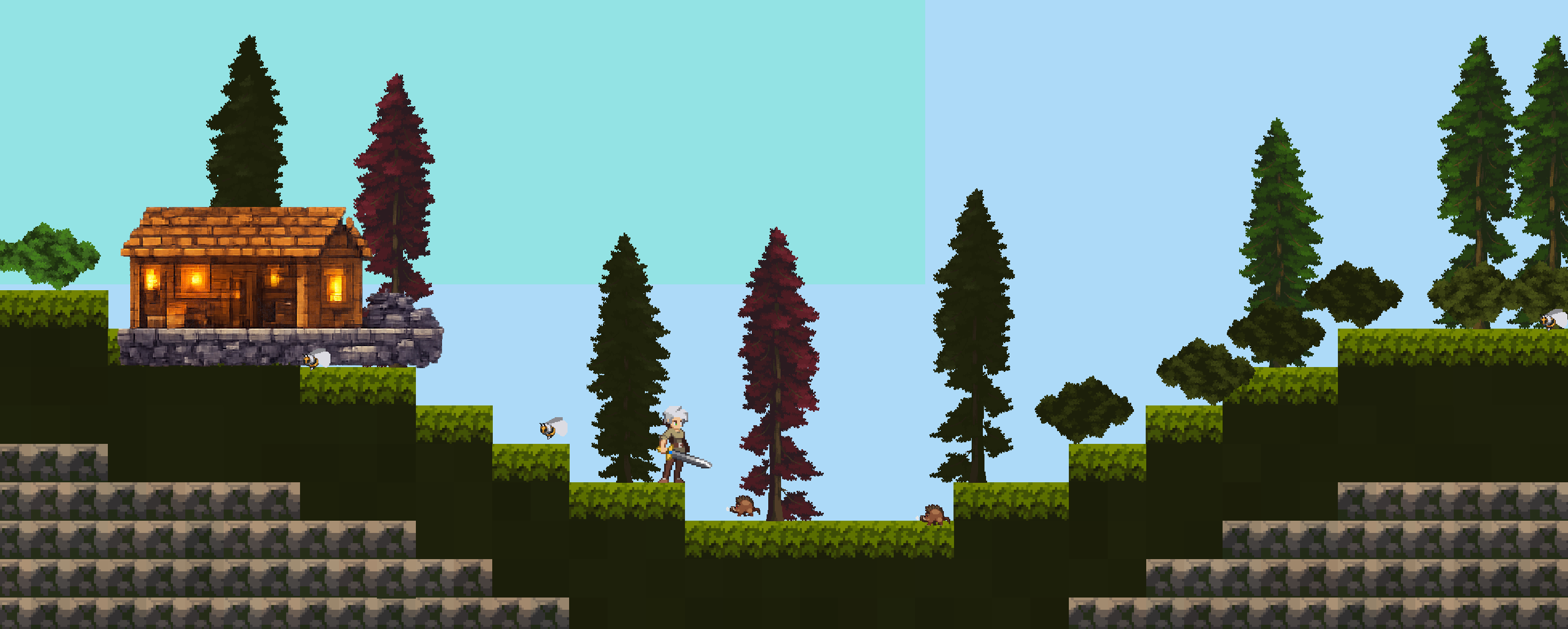
The sprite_dig_demo (examples/sprite_dig_demo.rs, 1706 lines) is the proof of concept. A complete 2D side-scrolling sandbox mining platformer. About 5,500 terrain tiles. An animated hero with idle, run, jump, and fall sprite sheets. Critters with different behaviours. Mining by click-hold that breaks objects in three stages with crack overlays. Right-click places from the hotbar. Terrain collision through a heightmap that opens real holes when you mine. The cabin windows emit warm amber light through the radiance cascades system. Mining a hole clears the occupancy bitset and light pours into the hole in real time.
70+ sprite sheets are automatically sliced and shelf-packed into a single texture array atlas. One add_atlas_layer call per sheet. The atlas layer index goes into SpriteInstance::atlas_layer, and the shader samples from texture_2d_array without branching.
The Stress Test
examples/sprite_stress_test.rs is the bunnymark equivalent. 20,000 sprites bouncing around with CPU-driven positions via update_sprite each frame. Rolling FPS counter. Override with HELIO_SPRITE_STRESS_COUNT.
This one is useful for profiling the CPU-side upload path. Each frame touches every sprite through update_sprite, which marks every slot's byte range in the dirty bitmap. prepare() then uploads the full buffer. The stress test proves the dirty-range tracking works correctly at the boundary case where everything changes every frame. The actual cost is one GPU copy of the full instance buffer, which at 20,000 sprites is 1.6 MiB. At 60 fps that is 96 MiB/s of upload bandwidth. Negligible on any PCIe Gen 3 or newer bus.
Platform Constraints
| Constraint | Answer |
|---|---|
No MULTI_DRAW_INDIRECT_COUNT on WebGPU | Exactly 1 draw_indexed_indirect call |
MAX_STORAGE_BUFFER_BINDINGS on wasm/Metal | Separate bind groups for instances, draw_order, uniforms |
| 800 MiB instance buffer on integrated GPUs | reserve() with a smaller count; the demo uses adapter.limits() so it fails early if the allocation can't fit |
| Fixed capacity for cull + simulate passes | reserve() before wiring; reallocation not handled |
| Alpha blending requires correct depth order | Depth sort via GPU radix sort, not hardware depth test |
32 MAX_COLOR_ATTACHMENTS | Alpha blending only; no MRT |
max_visible sized to full pool | Panning or zooming out can never silently drop sprites |
The fixed-capacity constraint on SpriteCullPass and SpriteSimulatePass is a deliberate trade. Both are wired to specific buffer handles at construction and cannot handle them being reallocated afterward. Call SpriteBatchPass::reserve() before wiring GPU culling. This is enforced by documentation, not by the type system. A future version could use GrowableBuffer's reallocation signalling across passes, but the current use case — allocate once at scene load, never change — has not yet justified the complexity.
The Pattern
Helio 2D runs on a single principle: the GPU computes its own draw count, its own sort order, its own physics, its own lighting. The CPU sets a view rect, a delta time, and an emitter list. Then it gets out of the way.
The four passes are independent crates because they are independent concerns. No pass imports another pass's types. They share a byte layout, a few buffer handles, and a graph ordering convention. You can swap the simulate pass for a CPU-driven update. You can skip the cull pass and draw the whole pool unsorted (wasteful but correct). You can omit the radiance cascades entirely and the sprite batch renders just fine.
The dig demo is the fullest expression. 5,500 terrain tiles, 70 atlas layers, a mining system, real collision, animated characters, real-time 2D global illumination — all of it running through four GPU passes and a handful of draw_indexed_indirect calls. The CPU spends its frames on input polling and UI, not on iterating sprites.
Helio is open at github.com/Far-Beyond-Pulsar/Helio. The 2D passes live in crates/passes/2d/. The demos are in crates/examples/.