
rust
Type-Agnostic Reflection: How Pulsar's Property Editors Shed JSON, Became Entities, and Stopped Knowing What They Were Editing
How Pulsar's property editor system evolved from JSON-mediated stateless function pointers to entity-based factories with type-erased value channels — and why eliminating type knowledge from the framework layer made the entire editor registry extensible without per-type boilerplate.

The Old Model: JSON In, Elements Out
Pulsar's property system started with a straightforward premise: each type registers an editor function, and the properties panel calls that function with the current value (serialized as JSON) and gets back a GPUI element to render. The editor was a pure function — fn(&PropertyEditorArgs) -> AnyElement — with no state, no lifecycle, and no ownership of widgets.
The PropertyEditorArgs struct carried everything the editor might need:
Two value channels (current_json and current_value). Two type-specific callback slots (on_bool_toggle, on_enum_select). The PropertyEditorRegistry was a HashMap<TypeId, PropertyEditorFactory> where each factory received this struct and returned an element. Editors dug into current_json to read the value, and called on_bool_toggle or on_enum_select to push changes back.
This worked, but it encodes type knowledge in the framework layer. The properties panel — which should be completely generic — had to know that booleans use on_bool_toggle and enums use on_enum_select. Every new type category required a new callback slot. The PropertyEditorArgs struct grew with each type category added.
Worse, editors were stateless. They couldn't own widgets. A bool editor that wanted to render a toggle button had to build the button fresh every frame, because the editor function was called, returned an element, and disappeared. Child entity ownership, subscriptions, and focus state all had to be managed externally through an init-hooks system that added another layer of inventory registration.
The init-hooks system (UiPropertyEditorInitHint) was a separate inventory path where editors registered initializer functions that the framework called once to create widget entities. The editor function would then receive a handle to those entities via the args. Two registration paths per editor. Two inventory submissions. A constant dance between "init" and "render" phases.
Phase 1: One Value Channel
The first step was collapsing the two value channels into one. current_json was vestigial — once editors had typed current_value, most of them stopped reading from JSON. The field was always Value::Null in practice. Removing it cleaned up a dead second path that invited editors to reach for serialization instead of downcasting.
The commit message says it plainly:
The field was always
Value::Nullafter editors moved to typed values, so it was a dead second value channel that invited editors to reach for JSON instead of downcasting.current_valueis now the only way in; serialisation stays the data source's concern.
One value channel. One direction. The editor receives &dyn Any and downcasts to its own type. JSON encoding and decoding happens only at the system boundary — the scene database produces JSON, the properties panel deserializes it into Box<dyn Any>, and the editor receives a typed reference. The reverse path is the same: the editor hands back Box<dyn Any + Send>, the panel serializes it to JSON, the scene database stores it.
This was the prerequisite for everything that followed. With one value channel, the editor contract was simple enough that the next step — making editors into entities — became tractable.
Phase 2: Editors Become Entities
The init-hooks system existed because editors couldn't own their own state. A widget that needed InputState, NumberInput, or DropdownMenu had to pre-create these entities in an init hook, store them somewhere the framework could find them, and then receive handles back during render. The init hook and the render function were separate code paths registered at separate times.
The refactor eliminated this entirely. Each editor became a GPUI entity — a struct implementing Render, with its own fields, its own child entities, and its own subscriptions. The factory function changed from returning an element to returning a BoundPropertyEditor:
A BoundPropertyEditor is two things: a renderable view handle (the entity) and a value-setter closure. The framework caches one of these per (class_name, property_name) pair. On construction, the factory creates the entity and returns the bound handle. On every subsequent render, the framework calls (editor.set_value)(current_value, window, cx) to push the latest value in.
The editor's set_value closure is generated by BoundPropertyEditor::new, which takes the entity and a typed setter:
The typed setter is called only when the &dyn Any actually holds a T. The downcast guard means editors never write downcasting boilerplate — they just handle &f32, &bool, or whatever their concrete type is. The type erasure is handled once, in BoundPropertyEditor::new.
The old init-hooks inventory path was removed. Editors now create their own child entities in their constructor:
Factory functions became minimal:
The PropertyEditorFactory type alias encodes the contract:
Take args, build an entity, return a BoundPropertyEditor. No init hooks. No JSON. No type-specific callback slots.
Phase 3: The Framework Stops Knowing About Types
With editors as entities and a single typed value channel, the framework layer — render_property_row_runtime in ui_common — became completely type-agnostic:
This function does not know what type_info describes. It does not branch on TypeStructure::Enum or TypeStructure::Primitive. It does not check whether the property is a boolean, a float, a string, or a colour. It finds the factory by TypeId, builds or retrieves the editor, pushes the value, and returns the view. That is the entire extent of its knowledge about the property.
The PropertyEditorRegistry confirms this. It's a single HashMap<TypeId, PropertyEditorFactory>, populated from inventory::collect!(UiPropertyEditorHint) at startup. No type-specific dispatch. No special cases.
Every editor — whether for f32, bool, String, LightType, or [f32; 3] — is registered as a UiPropertyEditorHint linking its TypeId to a factory function. The framework never distinguishes between them.
The TypeId Trick That Made Enum Editors Generic
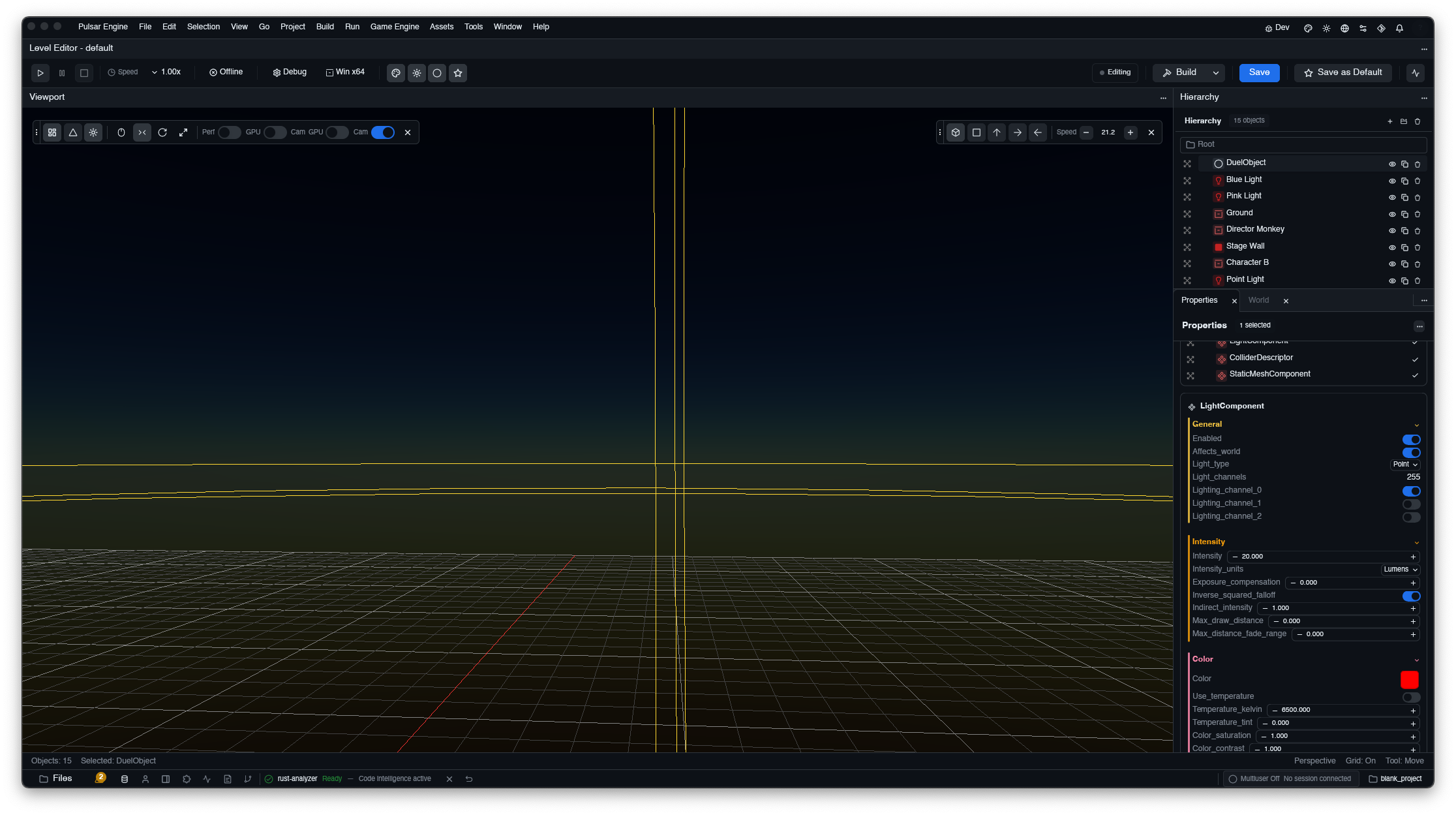
With the framework fully type-agnostic, the next problem became clear: enums were the only types without editors. #[derive(Reflectable)] registered them with the runtime type registry (for JSON serialization) but never submitted a UiPropertyEditorHint. The PropertyEditorRegistry had no entry for TypeId::of::<LightType>(), so the panel rendered "(nyi)".
The fix was a single addition to the derive macro:
Every #[derive(Reflectable)] on an enum now auto-registers a generic dropdown editor. The editor itself (enum_dropdown_editor) is completely type-agnostic — it serializes the current value to JSON via RUNTIME_TYPE_REGISTRY.serialize_json_for_any, extracts the variant index, renders a dropdown with the variant names from type_info.enum_variants(), and on selection deserializes the index back into the concrete enum type via deserialize_json_for_type.
This pattern was already possible with the old architecture, but it would have required adding on_enum_select: Option<fn(usize)> to PropertyEditorArgs and maintaining a separate dispatch path. With the type-agnostic architecture, it falls out naturally: the generic editor serializes and deserializes through the same runtime registry that handles all type-specific logic. The framework never needs to know that LightType is an enum — it just passes &dyn Any and write_back around.
The f64 Gap
The import configurator (for model files dropped into the content drawer) uses an import-options schema from the model-loader crate. One option kind is Float { min, max, step }, whose constraints are Option<f64>. The code that converts schema fields into ImportField instances does:
This panics. f64 was never registered as a primitive type. The prims/core/ directory had f32, i32, i64, u64, bool, [f32; 3], and [f32; 4]. No f64.
The fix was adding the missing file, following the same pattern as f32:
The gap existed because there was no automated check that every Rust primitive has a reflection counterpart. The import schema was the first system that needed an f64 in the property pipeline, and the first system that failed because of it.
What Changed
The architectural evolution crossed three boundaries:
| Layer | Before | After |
|---|---|---|
| Editor identity | Stateless function pointer | Entity with lifecycle, children, subscriptions |
| Editor registration | Factory returning element | Factory returning BoundPropertyEditor (entity + value-setter) |
| Value channel | current_json + current_value + type-specific callbacks | current_value: &dyn Any + write_back: Box<dyn Any + Send> |
| Widget initialization | Separate UiPropertyEditorInitHint inventory path | Editor constructor (cx.new) — standard GPUI entity lifecycle |
| Framework knowledge | Knew about bool toggles, enum selects, JSON | Knows nothing — pure type-erased dispatch by TypeId |
| Enum editors | Manual build_enum_type_info(...) with TypeId hijack | Auto-registered via #[derive(Reflectable)] on any C-like enum |
| Primitive coverage | f32 but not f64 | Both registered |
The framework layer (render_property_row_runtime in ui_common) went from 158 lines with type-specific branching to 158 lines with none. The PropertyEditorRegistry went from a HashMap<TypeId, PropertyEditorFactory> with ad-hoc dispatch to a HashMap<TypeId, PropertyEditorFactory> with the same dispatch — the difference is that the dispatch no longer has special cases because the factory contract was reduced to its essentials.
The enum dropdown editor is the proof that the architecture works. It was added in a single commit without touching the framework layer. The factory registered itself, the runtime registry picked it up, and the properties panel started rendering dropdowns for every enum field in the engine — LightType, IntensityUnits, MobileQualityLevel, ShadowCacheMode, and any enum any plugin registers in the future. No per-type registration. No framework changes. No JSON path. Just a UiPropertyEditorHint pointing to a generic function.
That's the measure of type-agnostic design: adding a new category of editor doesn't require changing anything except the editor itself.