
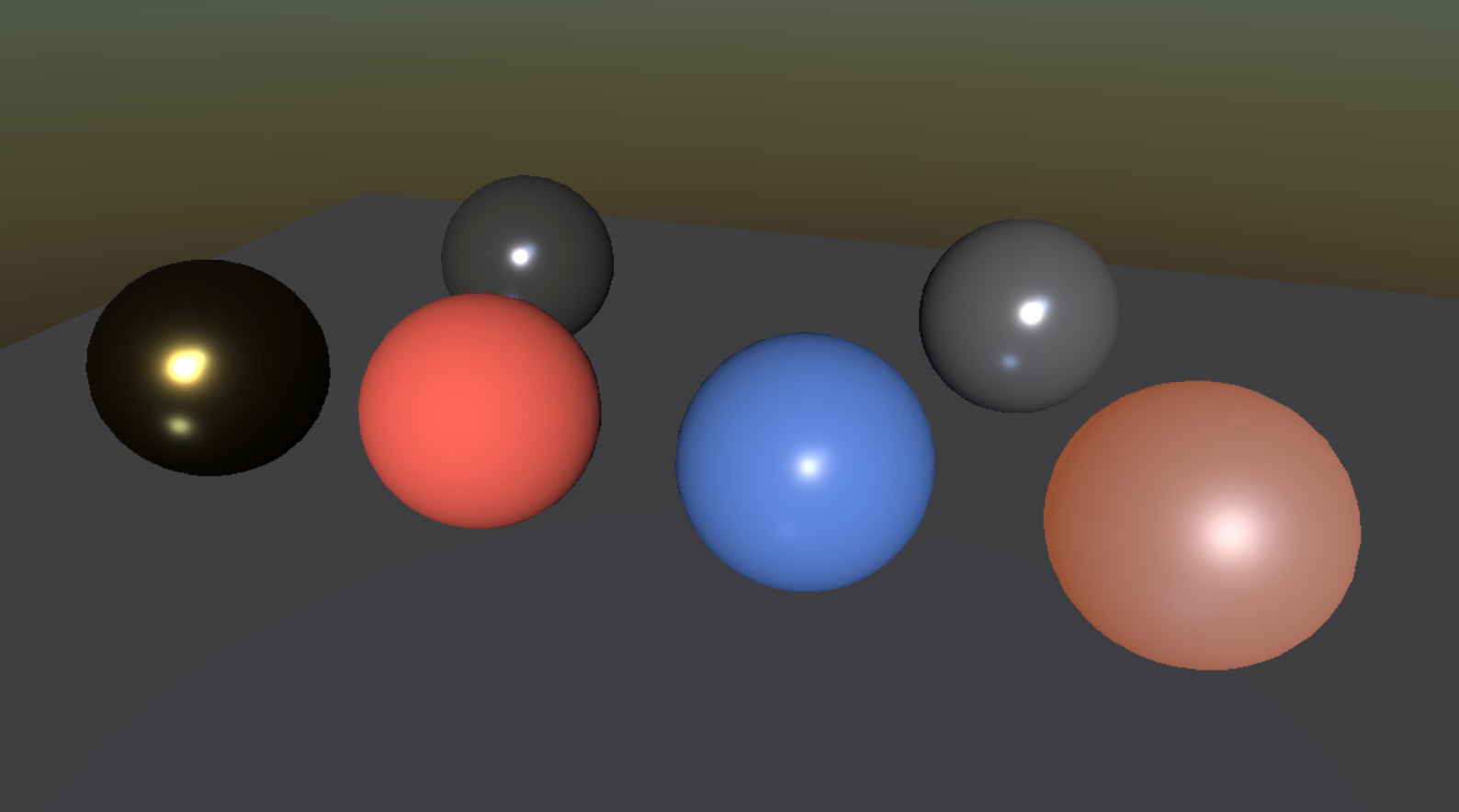
rust
Helio Radiant: Zero-Cost Custom Materials Through Template Fusion
How Helio's Radiant material system combines hand-authored shader templates with graph-generated WGSL snippets to deliver custom surface shaders with zero per-permutation PSO cost — through warp-uniform feature branches, lazy shader compilation, and draw-call grouping by material class.

When PBR Isn't Enough
Helio was built around a deferred PBR pipeline. Every material shared the same GBuffer shader. The GpuMaterial struct stored base color, roughness, metallic, emissive, a few texture handles, and a workflow discriminant. The shader read these from a storage buffer and evaluated them the same way for every object. No branching, no specialization, no per-material code paths.
This was fast. One PSO. One multi_draw_indexed_indirect call. No permutation explosion, no compilation stutter, no pipeline-object cache to manage. The entire scene rendered through a single fragment shader variant.
But it was also rigid. Want clear coat? You'd need to pack it into unused channels and write a custom path in the deferred light pass. Want subsurface scattering? Same problem. Want a completely custom surface that writes the GBuffer differently based on artist-authored logic? The fixed material model couldn't express it. You could change parameters. You couldn't change the code.
The initial design assumed that PBR parameters covered enough of the surface space that a standardized evaluation function was sufficient. For most materials this is true. But the edge cases — the surfaces that don't fit — are exactly the surfaces that make a renderer look distinctive. A character's skin, a car's paint, a creature's translucent membrane. These aren't expressible through roughness and metallic alone.
The usual solution in AAA engines is shader permutations. Each unique material graph compiles to its own fragment shader variant. Unreal does this. Unity's HDRP does this. The result is artist freedom at the cost of PSO explosion. Unreal's ShaderCompileWorker exists because compiling hundreds of permutations for a single material change takes real time. The pipeline cache for The Last of Us Part II reportedly contained over 12,000 unique PSOs. Each PSO costs driver memory, pipeline-bind overhead, and compile latency.
Radiant is the middle path. It keeps one PSO for the common case and spawns new ones only when the artist explicitly writes custom code. The cost profile matches the flexibility: zero overhead for standard materials, linear cost for custom materials.
The GpuMaterial Evolution
Before Radiant, GpuMaterial was a 96-byte struct:
The _pad field was alignment padding. Every GpuMaterial construction site set it to zero. Radiant repurposed it into material_class, then extended the struct by 16 bytes for class_params:
112 bytes. Adding 16 bytes to a GPU storage buffer isn't free — it increases the stride for every material slot. With 2048 material slots, that's 32 KB of additional GPU memory. Negligible.
The flags field grew from 3 bits to 8:
The original three flags were already consumed by the render pipeline (double-sided controls cull_mode, alpha blend controls blend state, alpha test gates alpha discard). The new flags are evaluated inside the shader, not by the pipeline. They tell radiant_eval_surface which warp-uniform branches to take.
Every construction site across the workspace — the asset converter, the snapshot renderer, the web demos, the example code — needed updating. The compiler caught all of them. There were seven sites total.
The Three Tiers
Radiant categorises every material into one of three tiers. The tier determines what happens at draw time.
Tier 1: Feature Flags
The default PBR uber-shader is compiled once, at graph construction time. It contains warp-uniform branches gated by material flags:
The warp-uniform guarantee is worth examining. On NVIDIA hardware, a warp is 32 threads. On AMD, it's 64. On Apple Silicon, it's 32. Every thread in a warp executes the same instruction stream. When you hit a conditional branch, the GPU evaluates the condition and masks off threads that take the other path. If ALL threads take the same path, the cost is a single scalar comparison.
In a deferred renderer, the GBuffer pass processes visible fragments. These fragments come from triangles that were rasterized. Adjacent triangles tend to belong to the same object, which uses the same material. Adjacent pixels in screen space tend to fall within the same object's rasterized area. So pixels in the same warp almost always carry the same material ID, which means the same material.flags value.
The guarantee holds because material.flags is a per-material constant, not a per-pixel varying value. The only way a warp could split is if two triangles from different materials rasterize into the same 2×2 pixel quad. This can happen at material boundaries — the edge between a character's skin and their clothing. The cost is 32 threads taking one branch and the rest taking the other. The divergent paths serialize. For a single if check at a material boundary, this costs roughly 5-10 cycles of scalar math plus the latency of the divergent path. The GBuffer shader spends roughly 200-300 cycles waiting on texture fetches. The divergence cost is hidden by memory latency.
A material in Tier 1 never creates a new PSO. It sets flags on GpuMaterial.flags and the single compiled uber-shader handles the rest.
Tier 2: Template + Graph
When the flag system isn't enough, Radiant introduces a template. A template is a hand-authored WGSL file that contains radiant_eval_surface with replaceable override markers:
The RadiantTemplate::build_shader_source method handles the replacement:
The graph compiler outputs a WGSL fragment that replaces the markers. The fragment receives all variables in scope — material, material_tex, input, uv, N, albedo, ao, roughness, metallic, specular_f0, emissive — and can override any field of the returned SurfaceData:
The template author defines which variables the override can touch. The graph compiler must emit WGSL that is syntactically valid at the injection point. The engine trusts the compiler — it does no validation. If the injected code doesn't compile, create_shader_module returns an error, and the pipeline creation fails. The engine logs the error and falls back to a default material. The template registry can be updated at any time without restarting the engine.
Tier 3: Full Custom WGSL
Tier 3 is Tier 2 where the graph compiler outputs the entire radiant_eval_surface function body. The template still provides the SurfaceData struct definition, the GBufferOutput packing code, and all bind group declarations. But the evaluation function is 100% artist-authored.
This is the escape hatch. A surface that reads from a fluid simulation texture. A material that changes its BRDF based on the angle between the view vector and a directional light. A translucent surface that combines depth-based attenuation with custom fog. Any of these would require the template author to anticipate the use case. With Tier 3, the artist writes the full function and the template becomes a thin wrapper around the bind group layout and output format.
Tier 3 materials incur a PSO of their own. The cost is identical to Tier 2 — one PSO per unique graph hash.
How the Template Registry Works
Templates are stored in RadiantTemplateRegistry, a HashMap<u32, RadiantTemplate> owned by the GBuffer pass:
The built-in default PBR template is registered as class 0 at construction time, loaded via include_str! from gbuffer.wgsl. Additional templates are registered at runtime by external tools:
load_from_file reads the file, converts it to a &'static str via Box::leak, and assigns the next auto-incremented ID. register_str does the same from an owned String. The resulting ID is stored on the material via Scene::set_material_class.
The registry is reachable through GBufferPass::template_registry_mut(), which the renderer exposes through find_pass_mut:
This is the only path external tools need. They never touch the GBuffer pass internals directly.
How the Graph Registry Works
Graph snippets live in RadiantGraphRegistry, a HashMap<u64, String> owned by the Scene:
The graph_hash is a content hash computed by the external compiler. The engine never interprets it — it's purely a lookup key. Two materials with different graphs produce different hashes and different PSOs. Two materials with identical graphs produce the same hash and share a PSO.
The registry is populated at import time by the toolchain:
When the GBuffer pass encounters a material with graph_hash != 0, it looks up the snippet from ctx.scene.graph_wgsl_snippets (a per-frame snapshot of the registry) and passes it to get_or_create_pipeline.
If the hash isn't found in the registry, the engine logs a warning and uses "" as the snippet — the template runs in passthrough mode, equivalent to Tier 1 for that class. The material still renders, just without the custom override. This is deliberate: a missing graph snippet shouldn't crash the frame.
Draw Call Grouping by Material Class
The scene stores materials as a flat array indexed by MaterialId. Each object carries a material_id field. When the scene rebuilds its instance data — every frame, after GPU culling produces the visible set — it sorts instances by the material's (material_class, graph_hash) pair.
The sort is stable. Objects within the same class retain their original order, which preserves any artist-authored draw ordering. The implementation lives in rebuild.rs:
The (class, hash, start, count) ranges are uploaded to GpuScene::material_class_ranges and read by the GBuffer pass in execute(). Each range is guaranteed to be uniform in both class and graph hash, so it maps to exactly one PSO.
The persistent-mode rebuild runs every frame because GPU culling changes the visible set. The number of objects in a typical scene is in the hundreds to low thousands. The sort is O(n log n) on the CPU, but n is the visible object count, not the total scene size. For a scene with 800 visible objects and 4 material classes, the sort takes roughly 3-5 µs — against a frame budget of 16 ms, it's invisible.
The optimized-mode rebuild (used after optimize_scene_layout()) groups objects by (material_class, mesh_id, material_id) during the initial clustering pass. The material_class_ranges are compacted from the group boundaries. This path runs once, not per frame.
The PSO Table and Lazy Compilation
The GBuffer pass replaced its single pipeline field with three things:
RadiantShaderKey is a 16-byte struct:
get_or_create_pipeline checks the HashMap, compiles on miss, caches the result:
The vertex shader never changes between tiers — it reads instance data and transforms vertices identically regardless of material class. Only the fragment shader changes. But wgpu doesn't support separable PSOs (vertex/fragment independently), so we compile the full pipeline. The vertex module is identical across all variants, and the driver deduplicates the compiled vertex code internally.
get_or_compile in the shader cache calls RadiantTemplate::build_shader_source to concatenate the template with the graph snippet, then calls device.create_shader_module:
The cache is scoped to the GBufferPass instance. It persists across frames and resizes. The only way to clear it is to destroy the pass. This is deliberate: once compiled, a shader module is valid for the lifetime of the device.
The execute method iterates the ranges and issues one multi_draw per range:
The 20 in start * 20 is the byte stride of DrawIndexedIndirectArgs — five u32 values at 4 bytes each. This is a wgpu constant that never changes.
Edge Cases
Missing template class. If a material references a material_class that isn't in the registry, get_or_create_pipeline panics with "Unknown material template class". This is deliberate: a class ID without a registered template is always a programming error. The panic happens at pipeline creation time, not during rendering. The external toolchain is responsible for keeping class IDs in sync between the template registry and the materials that reference them.
Graph hash not found. If a material has graph_hash != 0 but the hash isn't in the graph registry, the engine logs a warning and passes an empty snippet. The template runs in passthrough mode. The material still renders — it just doesn't apply the custom graph. This is the only edge case that degrades gracefully. The rationale is that graph snippets can be unregistered independently of materials (e.g., when a graph compiler restarts), and crashing the renderer for a missing snippet would be hostile.
Mixed classes in a single draw call. Radiant doesn't support heterogeneous material classes within a single multi_draw. This is enforced by the sort: instances are grouped by (class, hash) before draw call generation. If the scene were to somehow produce a mixed-class range, the result would be that all objects in that range render with the first object's material class PSO. The class ranges are built from the material data, so this shouldn't happen. The cost of the check at sort time is zero.
Warp divergence at class boundaries. At the boundary between two objects with different material classes, a single warp can span pixels from both objects. The warp splits, and the divergent path serializes. The overhead is typically 10-20 cycles per boundary pixel. Against a 500-cycle shader, this is roughly 2-4% local overhead. Across the full frame, the number of boundary pixels is a tiny fraction of the total, so the global cost is undetectable.
PSO compilation on the first frame. When the first frame encounters a new template or graph snippet, create_shader_module compiles the WGSL source. This is a synchronous call on all backends. On Vulkan with GPL (graphics pipeline libraries), the compile takes roughly 1-3 ms per variant. On Metal, it's 2-5 ms. On DX12, it's similar. The first frame after adding a new material variant will have a visible hitch. Subsequent frames are free.
This is the same cost profile as Unreal's material system, but Radiant pays it less often. Unreal compiles a new permutation for every material graph change, even if the change is just a parameter tweak. Radiant compiles only when the template ID, graph hash, or flags change — parameter-only changes never trigger a recompile.
Comparing the Cost Profile
Unreal's system and Radiant's system both compile shaders, but they compile different things at different times.
In Unreal, every material graph produces a unique HLSL function. The function is compiled into every render pass permutation that uses that material. A scene with 50 unique material graphs and 4 render passes (depth, GBuffer, shadow, forward) produces 200 unique shaders. Each shader takes 1-5 seconds to compile. The total is 200-1000 seconds of shader compilation spread across the first load.
In Radiant, the default path produces exactly one shader: the default PBR uber-shader. It compiles once at graph construction time. Custom templates compile once per template when first encountered. Graph snippets compile once per unique snippet when first encountered. For a scene with 50 materials, none of which use custom graphs, the total is 1 shader compilation. For a scene with 50 materials, 5 of which use custom graph snippets on the same template, the total is 6 compilations.
The difference is 200 versus 6. Both numbers converge to zero after the first frame — the compiled shaders are cached. But the first-frame experience is substantially different.
The driver memory cost follows the same ratio. Unreal's 200 PSOs consume roughly 400-800 KB of driver memory (at 2-4 KB per PSO). Radiant's 6 PSOs consume 12-24 KB. Neither number is significant on a desktop GPU with 8-24 GB of VRAM, but on a mobile device or integrated GPU, the difference matters.
The pipeline-bind cost per draw call is identical in both systems: one set_pipeline call per material switch, approximately 1-2 µs on modern drivers. Unreal pays this cost more often because it switches PSOs more frequently. Radiant pays it once per class range, which is typically 2-5 switches per frame regardless of scene complexity.
What Radiant Doesn't Do
Radiant doesn't change the deferred lighting pass. Every material variant writes the same GBuffer format — albedo, normal, ORM, emissive, F0 packed into alpha channels. The deferred lighting shader reads these and evaluates the lighting pass identically. The material variant decision is entirely contained in the GBuffer shader.
This is a deliberate constraint. The GBuffer format is a contract between the GBuffer pass and the lighting pass. Allowing every material to extend it arbitrarily would require the lighting pass to handle dynamic channel layouts, which reintroduces the branching cost Radiant exists to avoid.
If you need a new surface channel — subsurface profile index, clear coat roughness, anisotropy direction — it must be added to the GBuffer format in the engine, not just in the material. The class_params field on GpuMaterial provides four custom float slots that don't touch the GBuffer format. Material-specific data that needs to reach the lighting pass must go through a separate buffer, keyed by material ID, that the lighting pass reads conditionally.
For most surface types, this constraint is not limiting. Clear coat, subsurface, and anisotropy parameters fit into existing channel budgets or into class_params. The graph snippet reads class_params like it reads any other parameter:
The Template Authoring Contract
A valid template is a complete WGSL file that compiles as a standalone GBuffer shader. It must define:
- All struct types the shader reads (
Camera,Globals,GpuInstanceData,GpuMaterial,MaterialTextureData,LightmapAtlasRegion) - All bind group declarations (camera, globals, instances, lightmaps, materials, textures, samplers)
VertexOutput,GBufferOutput, andSurfaceDatastructsvs_mainvertex shader entry pointradiant_eval_surfacereturningSurfaceDatawith// RADIANT_OVERRIDE_SURFACEmarkersfs_mainfragment shader entry point that callsradiant_eval_surfaceand packs the result
The template does NOT need to handle the graph snippet case. The RadiantTemplate::build_shader_source method handles the concatenation. The template author writes the function assuming the override markers are a no-op passthrough.
A minimal template can be derived from the default PBR template by changing the radiant_eval_surface body. The SurfaceData struct, GBufferOutput packing, bind groups, and vertex shader are identical across all templates. In practice, most templates will share these parts through a common base include, though WGSL's lack of #include directives means the common code must be duplicated or concatenated at the toolchain level.
Future Work
The current implementation is scoped to the GBuffer pass. The transparent pass uses a separate shader that doesn't go through radiant_eval_surface. Extending Radiant to cover transparent materials would require a similar template + override mechanism in the transparent pass shader. The same RadiantShaderKey and PSO table approach would work — the transparent pass would need its own template registry and shader cache.
The GBuffer format could be extended to support material-specific data channels. A material_extra storage buffer, indexed by material ID, could hold per-material data that the lighting pass reads conditionally. This would let custom materials pass data through to the lighting pass without changing the fixed GBuffer layout. The lighting pass would need a warp-uniform branch gated by a material flag, same as the GBuffer pass.
PSO compilation on the first frame is the one remaining user-visible cost. A disk cache for compiled shader modules would eliminate even the first-frame hitch. wgpu doesn't expose a persistent shader cache API, but the WGSL source itself can be cached and recompiled, which is faster than compiling from scratch because WGSL-to-SPIRV translation is the expensive step, not SPIRV-to-device-binary. A disk cache that stores RadiantShaderKey to WGSL source would save the template concatenation step on subsequent runs.
Radiant is open at github.com/anomalyco/Helio. The template system lives in crates/helio/src/radiant/template.rs, the graph registry in crates/helio/src/radiant/graph_registry.rs, the shader cache in crates/helio/src/radiant/shader_cache.rs, and the PSO table + draw-group iteration in crates/helio-pass-gbuffer/src/lib.rs.