
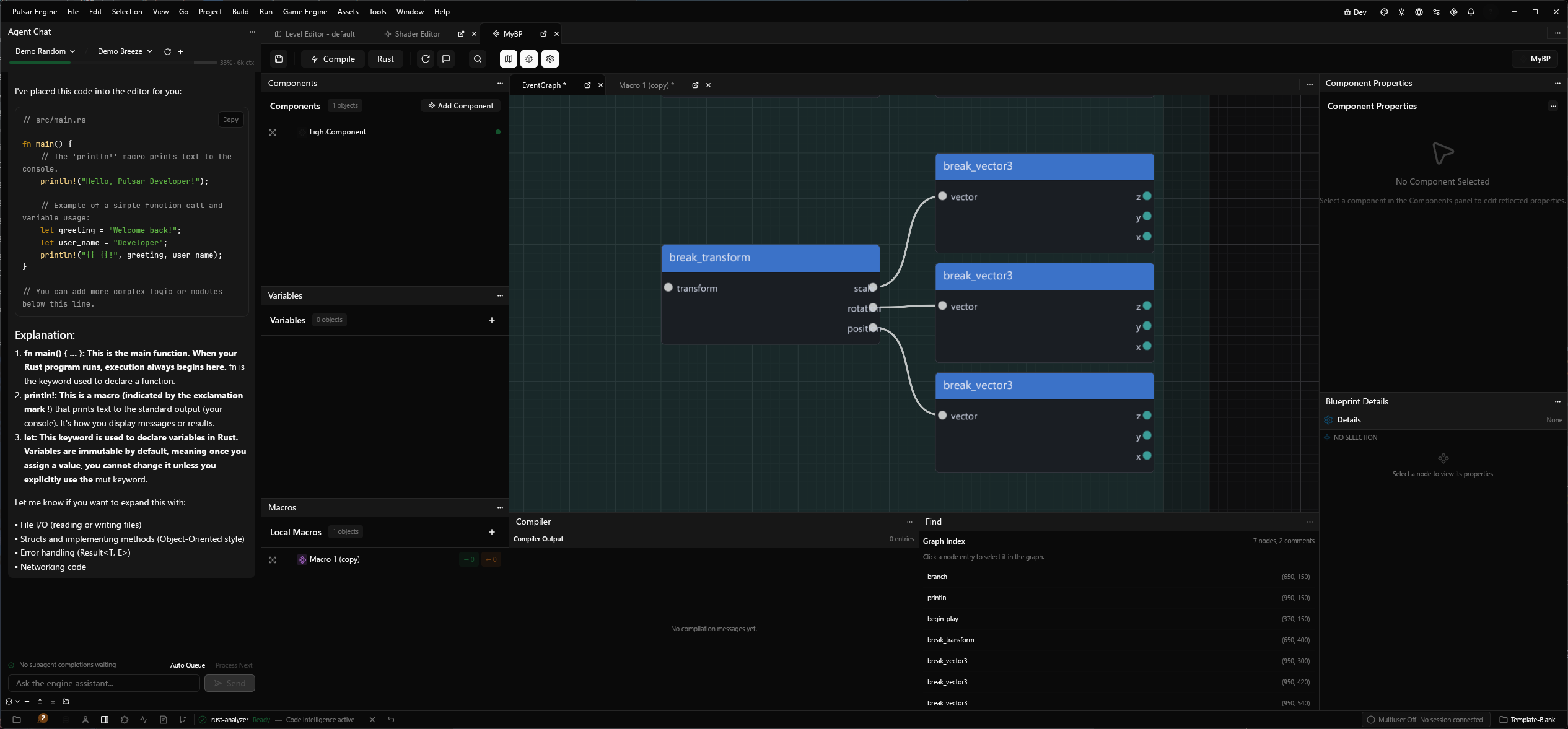

Visual node graphs have an asymmetry. You can trivially make a node with ten input pins. Most graph systems only let you have one output.
Unreal Engine works around this with special Break/Make nodes that the editor handles as a single unit. Shader editors in games often just ignore the problem. Your options are pass a vec4 around, or make three separate component-extract nodes. Neither scales.
We wanted something better. Not a one-off workaround for break nodes. A general mechanism that works across all three backends. WGSL for shaders. Rust for blueprint function calls. The bytecode VM for runtime dispatch. No additional ABI complexity. No runtime overhead. No special cases in the editor.
The Core Problem
A GPU function can only return one value. A Rust function can return a tuple, but the blueprint executor dispatches through a C ABI shim that writes to a single output slot. The shader editor's vec3_split node just passed the input through. Individual components were extracted by separate vec3_x, vec3_y, vec3_z nodes, each generating its own let binding.
This worked. It also meant that breaking a vec4 into its four components required four node instances. One for the split. Three for the component extracts. The wire count grew quadratically with the number of components you needed. The graph became visually noisy with intermediate nodes that existed solely to rename fields.
The constraints were concrete. No multi-return in the target language. One let binding per node in the codegen. One output arena slot per node in the bytecode VM. Backward compatibility with thousands of existing single-output nodes.
The Accessor Pattern
The solution is a structural decomposition at the metadata layer, not the codegen layer. We introduced OutputParam. A named output pin that carries an accessor string.
Each node still emits exactly one let binding. The accessor gets appended at the consumer site.
The codegen never interprets the accessor. It is an opaque string. Could be .r. Could be .0. Could be [0]. Whatever the target language needs. The node author writes it as metadata.
effective_outputs() handles backward compat. When output_params is empty, it synthesises a single "result" pin with accessor "". Matches every existing node.
How Each Compiler Treats It
The accessor pattern is the same concept in all three backends. Each interprets it differently based on its native ABI.
WGSL
The shader codegen emits a single let binding. When a downstream node references an output pin, the codegen looks up the source node's effective_outputs(), finds the matching pin by name, and appends its accessor.
The fast path handles the common case. 200+ single-output nodes return the empty string immediately.
Rust
For multi-output functions, the Rust function returns a tuple. The codegen emits a temporary for the tuple, then one destructuring let per output pin.
The accessor strings .0 and .1 come from the source node's OutputParam. Same mechanism as WGSL. Different accessor values.
Bytecode VM
The bytecode codegen allocates a single arena slot large enough for the packed tuple. Field offsets within that slot are computed using Rust's layout rules. Instruction::Call carries the base offset. resolve_input_offset computes per-field accesses.
The dispatch shim writes the packed tuple to the base slot unchanged.
Consumers read from the same base slot plus the field offset. No tuple destructuring at the bytecode level.
The same dispatch ABI works for single and multi-output. For single-output functions, the tuple is a trivial one-element struct. ret points to a single value. For multi-output, it points to a larger packed tuple. The shim never needs to know which case it is.
User-Facing Interfaces
We provide two ways to declare multi-output nodes, plus a macro sugar for tight inner loops.
#[output] Attribute
The #[output] attrs map positionally to tuple elements. First attr gets accessor .0. Second gets .1. The proc macro validates that the number of attrs matches the return tuple arity at compile time. A mismatch is a hard error.
bp_return! Macro
The proc macro scans the function body for bp_return! invocations, extracts the label names, generates #[output] attrs from them, and replaces the macro invocation with return (expr1, expr2, ...). The expanded form is identical to the canonical version.
bp_return! is optional sugar. Everything works with just #[output] plus tuple return. The macro exists for functions where writing out the tuple return feels redundant.
#[conversion] Attribute
Same infrastructure powers automatic type conversion nodes.
The #[conversion] attr bakes a ConversionMeta struct into the node metadata. The ConversionRegistry in graphy scans for these and uses them to auto-insert conversion nodes when a user connects incompatible but convertible types. The shader editor and blueprint editor both use the same registry. A conversion node registered on the WGSL side is invisible to the blueprint editor, and vice versa. Each side loads its own metadata provider.
Frontend Usage
Multi-output nodes appear in the palette like any other node. No special icons. No separate category. A break_vec4 node shows four output pins labelled r, g, b, a and one input labelled v. A div_mod node shows two output pins labelled quotient and remainder.
Breaking and connecting happens through the normal drag-to-connect flow. You drag from break_vec4.r to a metallic pin. You drag from break_vec4.g to a roughness pin. The editor treats each output pin as an independent connection point. There is no special Break/Make editor mode.
The wire colour for each output pin matches the component type. r is f32. g is f32. The wires show the same type colour as any other f32 output pin. Hovering over a multi-output node highlights all its output pins simultaneously, so you can see the full decomposition at a glance.
Conversion nodes work the same way. Drag a white_noise_2d (f32) to make_vec4's x pin. Connect y, z, w from other sources. Or drop a white_noise_2d onto a vec4 input pin and let the auto-converter insert f32_to_vec4 for you. The auto-converter places the conversion node at the midpoint between source and target, fully undoable through the normal undo stack.
The reroute node also benefits. Double-click any connection line to insert a reroute. The reroute starts as a wildcard type. The first typed connection propagates its type through the reroute chain. Multi-output pins connect through reroutes without issue. The data flow analysis unwraps reroutes transparently, so the compiler never sees them.
Backward Compatibility
A node without output_params and without #[output] attrs produces exactly the same metadata as before. One "result" pin with accessor "".
Defaults to &[] in the linkme static registration. Every existing blueprint function continues to produce one output pin. No codegen change. No editor change. No migration.
Why Not Structs
The alternative to the accessor pattern is to have the node return a struct and let the editor decompose it. Unreal's Break/Make nodes work this way.
Structs are language-specific. A Rust struct has named fields. A WGSL struct has @location attributes. A C ABI struct has layout rules that may not match either. The accessor string is a single opaque token that each backend interprets in its own way. The WGSL codegen sees .r and appends it directly. The Rust codegen sees .0 and generates __result.0. The bytecode codegen sees .0 and computes a struct field offset. No shared struct layout required.
Structs require the consumer to know the struct definition. A consumer of a break node needs to know the struct's field names and types at graph-compile time. With accessors, the consumer just uses the source node's effective_outputs(). The same metadata API used for every other pin resolution. No special struct registry. No cross-module type resolution. No compile-order dependencies.
What It Feels Like
The whole system took about 600 lines across four crates. OutputParam in the metadata. Accessor appending in the codegen. #[output] in the macro. bp_return! for sugar.
The WGSL side was implemented first. break_vec2, break_vec3, break_vec4. Each one is a node that takes a vector and exposes its components as named output pins. The Rust/blueprint side followed with the macro support. The bytecode VM needed no ABI changes. The packed tuple slot makes multi-output a subset of the existing dispatch mechanism.
The nicest outcome is that multi-output nodes are indistinguishable from single-output nodes in every layer except the metadata. The editor draws the same pins. The codegen emits the same let bindings. The executor dispatches through the same extern "C" shim. OutputParam is just another field on NodeMetadata with a few backend-specific interpretations of the accessor string.